
What is the scam?
The Social Security scam is a government impersonation scam where scammers contact you by phone, email, text, or even physical mail claiming to be from the Social Security Administration (SSA) or the SSA’s Office of the Inspector General (OIG). They tell you that your Social Security number (SSN) has been suspended, linked to criminal activity, or compromised, and that you need to take immediate action to protect your benefits or avoid arrest.
Social Security is the most impersonated government agency in the United States. In fiscal year 2024, the SSA’s OIG received 332,927 reported scam allegations, with approximately half involving false personation (26.7%) or SSN misuse (23.9%). Government impersonation scams as a whole cost Americans $577 million through November 2024 and $789 million for the full year — and the Social Security version accounts for the largest share.
These scams target people of all ages, but older adults are disproportionately affected in terms of financial loss. The number of adults over 60 who reported losing $10,000 or more to impersonation scams increased more than fourfold between 2020 and 2024. Those reporting losses over $100,000 jumped nearly sevenfold in the same period. The scam works because Social Security is deeply tied to people’s financial security, and the threat of losing benefits or having your number “suspended” triggers immediate fear.
How this scam usually works
Social Security scams take several forms, but they all rely on the same core tactic: impersonate a government authority, claim your SSN is in danger, and pressure you into sending money or revealing personal information.
The “SSN suspended” phone call
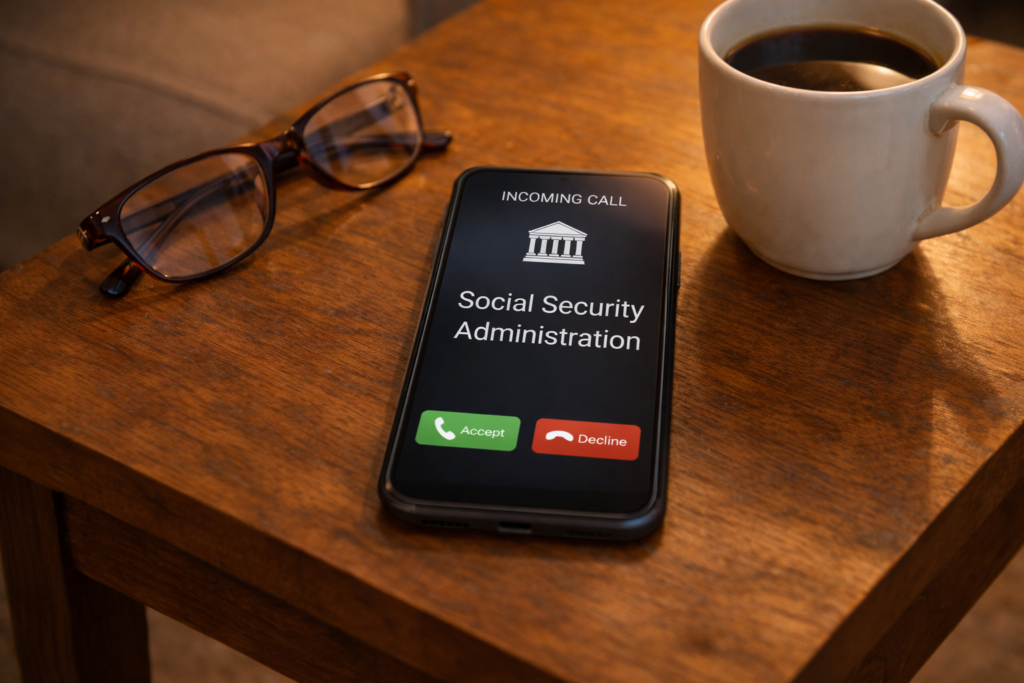
This is the most common version. You receive a phone call — sometimes a robocall, sometimes a live person — claiming to be from the Social Security Administration. The caller tells you that your Social Security number has been “suspended” due to suspicious or criminal activity. They may say your SSN was used to open fraudulent bank accounts, linked to drug trafficking, or connected to money laundering.
The caller provides a fake case number and badge number to sound official. They tell you that unless you act immediately, your benefits will be frozen, your bank accounts will be seized, or a warrant will be issued for your arrest. To “resolve” the issue, they instruct you to verify your identity by providing your full Social Security number, date of birth, and bank account details. In other versions, they tell you to transfer money to a “safe account” to protect it during the investigation.
The critical fact these scammers rely on you not knowing: Social Security numbers cannot be suspended. The SSA does not call people to threaten arrest or demand immediate payment. This claim is always a scam.
The phishing email and letter version
A newer tactic involves emails with subject lines like “Alert: Social Security Account Issues Detected.” The email contains an attachment that looks like an official government document — stamped with “Official Document” and “Official Government Communication” — claiming your SSN will be suspended within 24 hours due to criminal activity linked to your number.
The SSA OIG has warned about these emails specifically, noting that scammers use fabricated signatures of high-profile officials (including, in some cases, the name of the Supreme Court Chief Justice) and reference non-existent agencies like the “Drug Enforcement Agency” (the real agency is the Drug Enforcement Administration).
Physical letters are also used. You receive an official-looking notice in the mail claiming your SSN has been compromised and instructing you to call a phone number to resolve the issue. The number connects you to a scammer, not the SSA.
The hybrid scam — tech support to government impersonation
The SSA OIG has flagged a growing trend of “hybrid scams” that combine multiple impersonation tactics. In one common version, you first receive a fake tech support alert — a pop-up on your computer or an email claiming to be from Amazon, PayPal, or Microsoft saying your account has been compromised. You call the number provided and speak with a “tech support agent.”
During that conversation, the agent “discovers” that your Social Security number has been used in criminal activity. They offer to connect you with a “Social Security representative” for further help. You’re then transferred to a second scammer who poses as an SSA employee, escalating the scenario into threats about arrest, benefit loss, or account seizure.
This handoff between scammers makes the situation feel more real — you weren’t cold-called about Social Security, you “discovered” the problem yourself during a tech support interaction. The escalation pattern is similar to what’s used in the IRS impersonation scam, where victims are passed between fake “agencies” to build credibility.
Payment demands
Once you’re convinced the threat is real, the scammer tells you to send money to resolve the issue. They may instruct you to buy gift cards and read the numbers over the phone, wire money to a “government account,” deposit cash into a Bitcoin ATM, or even purchase gold bars and hand them to a courier who comes to your home.
In 2024, 33% of older adults who lost $10,000 or more to government impersonation scams reported paying with cryptocurrency, most often through Bitcoin ATMs. Bank transfers accounted for 20%, and cash payments for 16%. For a deeper look at why scammers demand these specific payment methods, see Why Scammers Ask For Gift Cards, Crypto, and Zelle.
How it works step by step
- You receive initial contact. A phone call, email, text, or letter arrives claiming to be from the Social Security Administration or OIG. It references your Social Security number and claims criminal activity has been detected.
- The scammer establishes authority. They provide a fake badge number, case file number, and may reference real government agencies or officials by name. Some use caller ID spoofing to make the call appear to come from the SSA’s real phone number.
- They create fear and urgency. You’re told your benefits are at risk, your bank accounts will be frozen, or you face arrest. The scammer won’t let you hang up, consult anyone, or take time to verify the claim.
- They ask you to “verify” your identity. You’re asked to confirm your Social Security number, date of birth, bank account numbers, or other personal details. This information is then used for identity theft.
- They demand payment. You’re told to transfer money, buy gift cards, use a Bitcoin ATM, or hand cash to a courier. The payment is described as necessary to “protect” your benefits, “clear” your name, or “secure” your accounts.
- The scam may escalate. You’re transferred to additional fake “agents” from other agencies — FBI, DEA, local police — who reinforce the threats and demand more money. Some victims are kept engaged for days or weeks.
- Follow-up contact. Some scammers call back days later, posing as a different agency offering to help recover the money — for another fee.
Real-world examples
A woman in Ohio was contacted by scammers impersonating Social Security and other government agencies in what investigators described as a “long con” lasting several months. Over the course of the scam, she was convinced her SSN had been compromised and that she needed to protect her assets. She liquidated more than $500,000 in retirement savings to purchase gold, which she then handed over to scammers who sent couriers to her home to collect it. She later described the scammer she spoke with daily: “They were so slick… he had an answer for everything and he was smooth. I had no question he was who he said he was.”
The India-based call center conspiracy, investigated by SSA OIG and federal law enforcement, involved callers who impersonated SSA and other government officials, telling victims their Social Security numbers were connected to criminal activity. Victims were instructed to send money via gift cards or cash shipped in packages to “protect” their assets and avoid arrest. The operation targeted thousands of Americans, with individual victims losing tens of thousands of dollars.
Multiple cases involving deceased beneficiaries were prosecuted in 2024-2025. In one case, a woman from Cheney, Washington was charged with converting over $28,000 in disability benefits intended for her uncle after he died. In another, a woman from Sitka, Alaska was charged in a three-year scheme that diverted more than $107,000 in SSA benefits meant for her father. A third case involved a woman from Anchorage who allegedly stole over $50,000 in benefits from her stepfather along with his COVID-19 stimulus payment.
These cases show the two sides of Social Security fraud: organized impersonation scams that target innocent people with threats, and benefit theft by individuals who exploit the system after a family member dies.
Red flags: Real SSA contact vs. scams
| How the Real SSA Contacts You | Scam Warning Signs |
|---|---|
| Sends letters through the U.S. mail for most communications | Calls out of the blue claiming your SSN is suspended |
| May call you, but never threatens arrest or demands payment | Threatens arrest, lawsuit, or benefit suspension |
| Never asks you to pay by gift card, wire transfer, cryptocurrency, or cash | Demands payment by gift cards, Bitcoin ATM, wire transfer, or cash |
| Never asks you to send money to protect it | Says you need to move your money to a “safe account” |
| Your SSN cannot be “suspended” — that’s not how it works | Claims your Social Security number has been “suspended” |
| Never asks you to keep their communication a secret | Tells you not to tell anyone about the call or investigation |
| Provides information you can verify at ssa.gov or by calling 1-800-772-1213 | Provides a different callback number or won’t let you verify independently |
| Will never send someone to your home to collect money | Sends a courier to your house to pick up cash or gold |
The most important rule: Your Social Security number cannot be suspended, revoked, or frozen. Any message claiming otherwise is a scam, every time.
How to protect yourself
Know that the SSA will never threaten you. Real Social Security employees don’t threaten arrest, demand immediate payment, or pressure you to act before consulting anyone. If a caller uses these tactics, it’s a scam. Hang up.
Never give your Social Security number to someone who contacts you. The SSA already has your SSN. They would never call you and ask you to “confirm” it. If someone contacts you asking for your Social Security number, don’t provide it — regardless of who they claim to be. For more on how government agencies and companies actually operate, see What Real Companies Will Never Ask You To Do.
Verify any SSA communication independently. If you receive a call, email, or letter claiming to be from Social Security and you’re unsure whether it’s real, hang up or set the letter aside. Then contact the SSA directly at 1-800-772-1213 or visit ssa.gov. If the issue is real, it will be on your record.
Don’t trust caller ID. Scammers spoof phone numbers to make calls appear to come from the SSA’s real number. A legitimate-looking caller ID means nothing. Always verify by calling the SSA back at their official number.
Be skeptical of “investigations” that require money. No government investigation requires you to pay money to clear your name, protect your benefits, or secure your accounts. If anyone — claiming to be from any agency — tells you to buy gift cards, use a Bitcoin ATM, or wire money as part of an investigation, it’s a scam.
Create a my Social Security account. Set up an account at ssa.gov/myaccount to monitor your benefits, earnings history, and any activity on your account. This gives you a direct way to check whether anything unusual has actually happened.
What to do if you’ve been affected
If you received a suspicious call but didn’t engage: Report it to the SSA OIG at oig.ssa.gov or call 1-800-269-0271. You can also report to the FTC at reportfraud.ftc.gov. These reports help investigators track and disrupt scam operations.
If you shared your Social Security number: Act quickly to protect your identity. Place a fraud alert on your credit reports by contacting Equifax, Experian, or TransUnion. Monitor your credit at annualcreditreport.com for new accounts you didn’t open. Consider placing a credit freeze to prevent anyone from opening new accounts in your name. File your tax return as early as possible to prevent a scammer from filing a fraudulent return using your SSN. Create or check your my Social Security account at ssa.gov to verify your benefits haven’t been redirected. See How To Secure Your Online Accounts for additional steps.
If you sent money: Contact the payment provider immediately. For gift cards, call the issuer (Apple, Google, Amazon) with the card numbers — funds may not have been redeemed yet. For wire transfers, contact your bank and request a reversal. For Bitcoin ATM payments, contact the ATM operator. Report the financial loss to the FTC and file a complaint with the FBI’s IC3 at ic3.gov.
If an older family member is being targeted: Approach the conversation with patience and empathy. The victim is scared and believes they’re in legal trouble. Direct confrontation often pushes them closer to the scammer’s narrative. Our guide Someone I Love Might Be Getting Scammed provides specific strategies for having this conversation without causing the person to shut down.
Remember: you won’t be punished for reporting. The SSA has stated explicitly that “you will never be punished by the government for falling victim” to a scam. Reporting is how these operations get disrupted.