
What is the scam?
Investment and get rich quick scams promise high returns on your money through fake trading platforms, cryptocurrency schemes, fraudulent business opportunities, or phony investment programs. The scammer’s pitch varies — it might be a “guaranteed” crypto trading algorithm, a forex trading group, a real estate opportunity, or a social media side hustle — but the structure is the same: you put money in and never get it back.
Investment scams are the single most costly category of fraud in the United States. Americans lost $5.7 billion to investment scams in 2024, according to the FTC — more than any other scam type. The FBI’s Internet Crime Complaint Center recorded 41,557 cryptocurrency investment fraud complaints in 2024, a 29% increase from the year before, with $5.7 billion in associated losses. Through the first three quarters of 2025, losses had already reached $6.1 billion.
These scams affect people across every age group and income level. Younger adults (ages 20-29) report falling for investment scams more frequently, but older adults (ages 70+) lose significantly more money per incident. Social media is the most common contact method — the number of investment scam victims who first encountered the scam on social media grew from 4,889 in 2020 to 26,569 in 2024.
How this scam usually works
Investment scams take several forms, but they share common elements: promises of high returns, manufactured urgency, and payment methods that are difficult to reverse. Here are the most common versions.
Fake cryptocurrency and trading platforms
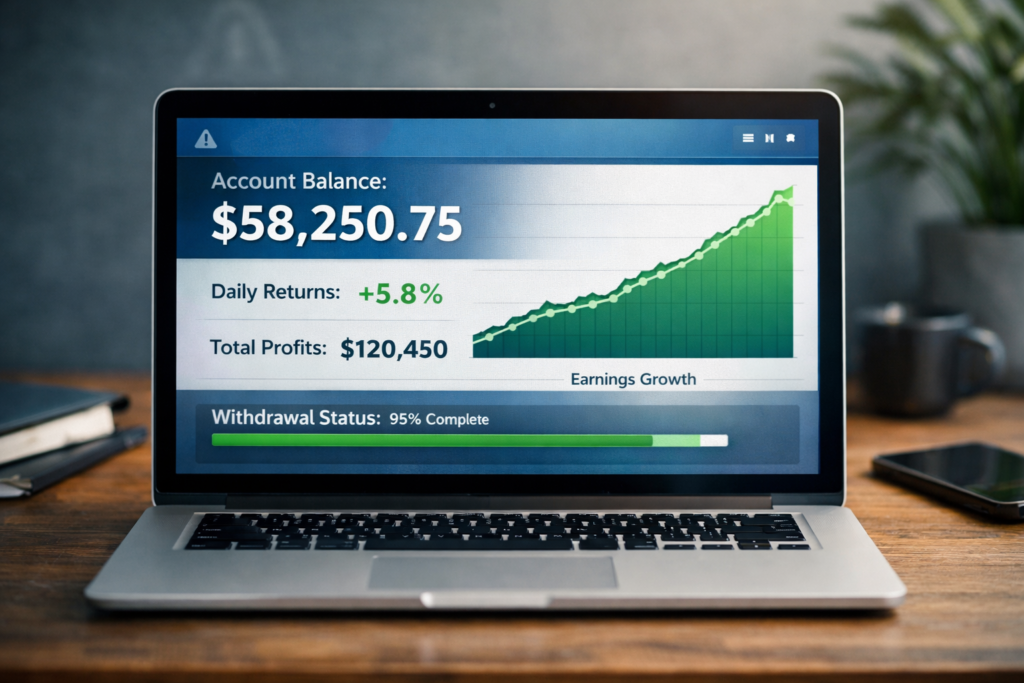
This is the fastest-growing investment scam type. You’re introduced to a cryptocurrency trading platform, forex trading site, or investment app that appears professional and legitimate. You create an account, deposit money, and watch your “balance” grow on screen. The dashboard shows impressive returns — sometimes 10%, 20%, or even 100% gains.
The platform is entirely fake. The numbers on screen are fabricated. Your money was transferred to the scammer’s account the moment you deposited it. The illusion of growing returns keeps you investing more.
When you try to withdraw your money, the platform demands additional payments — “tax fees,” “withdrawal processing charges,” or “account verification deposits.” Each new fee is positioned as the last step before you can access your returns. There is no last step. The fees are additional theft.
Joshua from Colorado was persuaded in February 2025 to invest in cryptocurrency on what he believed was a legitimate trading platform. He started with a small amount, then gradually invested more over several months as his dashboard showed growing returns. By June, he had invested close to $100,000 — nearly his life savings. The platform was fake, and the money was gone.
Pig butchering — the relationship-driven approach
“Pig butchering” is a term for investment scams that begin with a manufactured personal relationship. A scammer contacts you through social media, a dating app, or even a “wrong number” text and builds a friendship or romantic connection over weeks. Once trust is established, they casually mention an investment opportunity that’s been generating great returns for them.
The scammer walks you through setting up an account on a fake platform and may even guide you through your first deposit. Early on, you might be allowed to withdraw a small amount to prove the system works. This builds confidence and encourages larger deposits.
Pig butchering operations are often run by organized criminal networks, sometimes using trafficked workers forced to carry out the scams from compounds in Southeast Asia. The FBI reported over $3.5 billion in U.S. losses from pig butchering in 2023 alone, with global estimates exceeding $75 billion over four years. For more on how the relationship side of these scams works, see our article on the online romance scam.
Fake celebrity and influencer endorsements
Scammers create ads, social media posts, and even deepfake videos showing celebrities or financial influencers endorsing an investment platform. You see a convincing video of a well-known figure explaining how they made millions through a specific trading app. The video links to a registration page where you deposit money.
The celebrity never endorsed the platform. The video was generated using AI. The platform takes your deposit and either shows you fake returns to keep you investing or disappears immediately. Our article on the deepfake public figure endorsement scam covers the technology behind these fakes in detail.
Multi-level marketing and pyramid schemes
Some investment scams operate as multi-level marketing (MLM) programs where you’re encouraged to recruit other investors in exchange for commissions. The “investment” might be crypto trading, forex, or a vague “financial education” package. Returns come not from actual trading but from new investors’ deposits — the classic pyramid structure.
NovaTech, a crypto and forex MLM, raised more than $650 million from over 200,000 investors worldwide between 2019 and 2023. The SEC charged its founders for operating the scheme, which specifically targeted the Haitian-American community. Similarly, OmegaPro promised 300% returns over 16 months through forex trading. The Department of Justice charged its operators in 2025 after the scheme collapsed. HyperFund, a crypto pyramid scheme, raised over $1.7 billion from investors globally before the SEC filed charges in 2024.
Social media “money flipping” and side hustle scams
These scams target younger audiences on Instagram, TikTok, and Snapchat. A post or message promises to turn a small amount ($100-$500) into thousands through “money flipping,” “forex signals,” or a “proven system.” You send money and receive either nothing or a brief string of requests for more.
The scammer may use a hacked or stolen account belonging to someone you know, which makes the opportunity seem more credible. They might show screenshots of large bank balances or Cash App transfers as “proof” — all fabricated. Payment is typically requested through Zelle, Cash App, Venmo, or cryptocurrency. For more on why scammers prefer these methods, see Why Scammers Ask For Gift Cards, Crypto, and Zelle.
How it works step by step
Here’s the typical progression of an investment scam from first contact to loss:
- You encounter the opportunity. A social media ad, a message from a new contact, a recommendation from a friend’s compromised account, or a celebrity endorsement video catches your attention.
- The pitch sounds credible. The scammer or platform presents professional-looking materials — a polished website, testimonials, screenshots of returns, and sometimes real-time “trading” dashboards. The returns promised are high but not so extreme that they seem obviously fake.
- You start small. You’re encouraged to deposit a modest amount — $100 to $500 — to “test” the platform. This feels low-risk.
- You see “returns.” Your account dashboard shows your investment growing. You may be allowed to withdraw a small amount to build confidence.
- You invest more. Encouraged by the apparent returns, you increase your deposits. The scammer may suggest that larger investments unlock higher return tiers or VIP features.
- Withdrawal becomes impossible. When you try to take out a larger amount, the platform demands additional fees — taxes, processing charges, or verification deposits. Each fee is positioned as the final step.
- The platform disappears. Eventually the website goes offline, the scammer stops responding, or the platform simply stops processing any requests. Your money is gone.
Real-world examples
Joshua from Colorado began investing in cryptocurrency through what appeared to be a legitimate platform in February 2025. He was introduced to the opportunity online and started with a small deposit. As his dashboard showed growing returns, he invested more over several months. By June, he had put in nearly $100,000. The platform was entirely fake.
NovaTech’s founders, Cynthia and Eddy Petion, operated a crypto and forex MLM from 2019 to 2023 that raised $650 million from more than 200,000 investors worldwide. The SEC found that investor deposits were not being traded as promised. The scheme specifically recruited within the Haitian-American community, leveraging cultural trust networks to bring in new investors.
HyperFund, led by Xue Lee (also known as Sam Lee), raised $1.7 billion from investors worldwide through a crypto pyramid scheme. Investors were promised daily returns just for holding tokens on the platform. The SEC charged Lee and top promoter Brenda Chunga (known as “Bitcoin Beautee”) with fraud in 2024.
The FBI uncovered thousands of fake crypto platforms in 2024-2025, many operated from Southeast Asia. In one case, the SEC traced funds from fake platforms Morocoin, Berge, and Cirkor to bank accounts held by individuals in Southeast Asia. The platforms had defrauded retail investors of more than $14 million through WhatsApp-based recruitment and fake trading interfaces.
These cases range from individuals losing their savings on a single fake platform to organized operations stealing hundreds of millions. The common thread is that every platform looked legitimate until it was too late.
Red flags: Legitimate investment vs. scam
| Legitimate Investment | Investment Scam Warning Signs |
|---|---|
| Returns are modest and come with risk disclosures | Promises “guaranteed” returns of 10%+ monthly |
| Platform is registered with the SEC or FINRA | Platform has no registration or verifiable regulatory status |
| You can withdraw your money at any time | Withdrawal requires additional fees, deposits, or waiting periods |
| Information is publicly available and verifiable | Details about the company, team, or strategy are vague or unverifiable |
| No pressure to invest quickly | Urgency: “This opportunity closes tomorrow” or “limited spots” |
| You found the opportunity through your own research | Opportunity was introduced by an online contact or social media post |
| Investment advisor is licensed and verifiable | Advisor is anonymous or uses only a first name and messaging app |
| Returns fluctuate — sometimes up, sometimes down | Returns are consistently positive with no losses shown |
How to protect yourself
Verify before you invest. Check whether the platform and the people behind it are registered with the SEC (sec.gov/check-your-investment-professional) or FINRA (brokercheck.finra.org). Legitimate investment platforms are required to register with regulators. If the platform or advisor isn’t listed, don’t invest.
Be skeptical of guaranteed returns. No legitimate investment guarantees specific returns. All investing involves risk, and anyone who tells you otherwise is either uninformed or trying to scam you. Promises of “guaranteed 10% monthly returns” or “risk-free investing” are the clearest warning sign of a scam.
Don’t invest based on social media. Investment opportunities that come through Instagram DMs, TikTok videos, WhatsApp groups, or social media ads are overwhelmingly scams. This includes posts from friends whose accounts may have been compromised. Real investment opportunities don’t recruit through social media messaging. For a broader look at how legitimate companies communicate, see What Real Companies Will Never Ask You To Do.
Test withdrawals early and with significant amounts. If you’re already invested in something and want to verify it’s real, try withdrawing a meaningful amount — not just the small test withdrawal the platform encourages. Scam platforms are designed to allow small withdrawals to build trust. If a larger withdrawal is blocked or requires additional fees, stop investing immediately.
Research before sending more money. Search the platform name along with words like “scam,” “review,” or “complaints.” Check the Better Business Bureau, Reddit, and consumer protection sites. If multiple people report similar problems, trust their experience.
Never pay fees to access your own money. Legitimate platforms don’t charge “withdrawal taxes,” “processing fees,” or “verification deposits” to release your balance. These fees are a scam within a scam — additional money taken from you on top of what’s already been stolen.
What to do if you’ve been affected
Stop investing immediately. Don’t send additional money, even if the platform claims one more payment will unlock your funds. Every additional payment is additional loss.
Document everything. Save screenshots of the platform, your account dashboard, all transactions, and all messages with the person who introduced you to the investment. This documentation will be critical for any investigation or recovery attempt.
Report to the authorities:
- File a complaint with the FBI’s IC3 at ic3.gov — this is especially important for cryptocurrency fraud
- Report to the FTC at reportfraud.ftc.gov
- If the platform claims to be a securities investment, report to the SEC at sec.gov/tcr
- File a complaint with your state’s attorney general
Contact your bank or payment provider. If you sent money via bank transfer, contact your bank’s fraud department immediately. For cryptocurrency transactions, report the wallet addresses to the exchange you used. Recovery of crypto is difficult but not always impossible — the FBI’s Operation Level-Up has recovered over $285 million by intervening early in crypto scam cases.
Secure your accounts. If you created an account on the scam platform using credentials you use elsewhere, change those passwords immediately. See our guide on How To Secure Your Online Accounts for a full walkthrough.
Watch for recovery scams. The FBI issued a warning in 2025 about fake law firms and recovery services that target investment scam victims. They promise to recover your lost money for an upfront fee — and then steal that fee too. Legitimate law enforcement agencies never charge fees for assistance.