
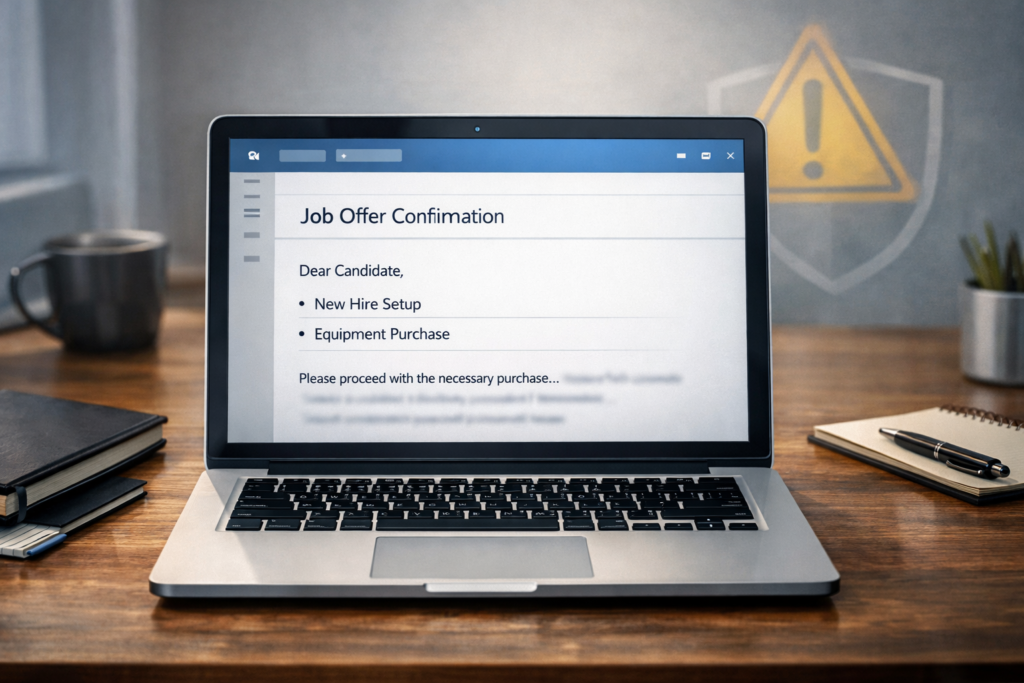
What is a fake job offer scam?
A fake job offer scam is when someone poses as a recruiter or employer to trick job seekers into handing over money or personal information. These employment scams typically begin with a job listing or unsolicited message that appears completely legitimate — featuring a real company name, professional job description, and salary that matches the role. Scammers have become increasingly sophisticated, making fraudulent job offers difficult to distinguish from genuine opportunities.
Scammers specifically target people actively job hunting, recently laid off, or seeking remote or flexible work arrangements. According to the Federal Trade Commission, thousands of employment scam reports are filed annually, with losses often exceeding thousands of dollars per victim. The scammer’s goal varies: some want an upfront payment for equipment or training, others seek your Social Security number and banking information under the guise of a “direct deposit form,” and some operate check overpayment schemes using a fake signing bonus.
Fake job listings appear on legitimate job platforms including Indeed, LinkedIn, ZipRecruiter, and Facebook. Scammers either post fraudulent listings directly or hijack the names and branding of real companies to make their offers look authentic. This blurs the line between legitimate job searching and falling victim to a job scam.
How fake job offer scams and employment fraud typically work
The scam typically starts with a job listing or direct message from someone claiming to be a recruiter. The listing describes a real-sounding role — often remote with a competitive salary and flexible hours. When you apply or respond, the fake hiring process moves unusually fast, sometimes within hours of initial contact.
Most fake job interviews happen entirely over text, email, or chat platforms like Google Hangouts, Telegram, or WhatsApp — never over video or phone. The recruiter explains this is standard practice for their company. Questions are generic and easy to answer, and within a day or two, you receive a job offer. This rapid progression is designed to minimize your time for verification.
Once you accept the offer, the scam shifts to one of several common patterns. In the equipment scam, you’re told the company will send you a check to buy your own home office setup. The check arrives, you deposit it, and you’re asked to wire the remaining balance to a vendor. The check bounces days later after you’ve already wired your own money — leaving you responsible for the full amount.
In the personal information scam, you’re sent new hire paperwork that requests your Social Security number, driver’s license, and bank account details for direct deposit. This information is used for identity theft, not payroll. Once scammers have this data, they can open fraudulent accounts, apply for credit, or sell your information to other criminals.
In the training or certification scam, you’re told the role requires a paid background check, training course, or software license that you must purchase upfront. After you pay, the recruiter disappears, leaving you without a job and out the money for the supposed training.
Common platforms where fake job listings appear
Employment scammers operate across major job platforms because they attract thousands of active job seekers daily. Indeed, LinkedIn, ZipRecruiter, and Facebook Jobs all have been used to distribute fake job listings, though each platform employs fraud detection systems. Smaller or less-monitored job boards sometimes have less stringent verification processes, making them attractive targets for scammers.
Social media platforms are also common channels for direct contact. Scammers search LinkedIn for recent graduates or people who’ve updated their job status as “looking for work,” then send direct messages with unsolicited job offers. Email is another frequent entry point — you may receive a message directly in your inbox claiming a recruiter found your resume on a job site.
Understanding where employment scams commonly originate helps you approach unexpected job offers with healthy skepticism. If you’re contacted directly with a job offer rather than finding a listing on the company’s official career page, additional verification is warranted.
Warning signs of a fake job offer scam
The interview process moves too fast. Real hiring processes involve multiple conversations — sometimes over several weeks — with different team members. If you receive a job offer within 24-48 hours of first contact with no phone or video interview, that’s a significant red flag.
The job was never officially posted. Scammers often reach out directly on LinkedIn or via text claiming they “found your resume.” If you can’t find the job listed on the company’s official website or careers page, it likely doesn’t exist.
Communication happens on unofficial channels. Legitimate recruiters use company email addresses and official platforms. If your recruiter is contacting you from a Gmail, Yahoo, or Hotmail account — or asking you to move conversations to WhatsApp or Telegram — treat it with caution.
The salary or benefits seem unusually high. A remote data entry role offering $35/hour with no experience required is worth questioning. Scammers use attractive compensation to lower your defenses and make the offer seem too good to pass up.
You’re asked for money or financial information before starting. No legitimate employer requires payment for equipment, training, or background checks from the employee. Requests for your bank account number before your first paycheck is issued are also a warning sign that you’re dealing with a fake hiring scam.
How to protect yourself from fake job scams
Before responding to any job offer, verify the company independently. Search the company name along with “careers” or “jobs” and look for the listing on their official website. Call the company’s main phone number — found on their website, not provided by the recruiter — and ask if the position exists and the hiring stage of the recruitment process.
Search the recruiter’s name and email address online. A real recruiter at a real company will have a legitimate LinkedIn profile, a company email address, and sometimes a history of other job postings. If nothing comes up, or if their profile was created recently with few connections, be cautious.
Never deposit a check and wire money to anyone as part of a job process, for any reason. Banks are required to make check funds available before a check clears — meaning you can spend the money and the check can still bounce days later. Once you wire money, it’s typically gone and unrecoverable.
Withhold your Social Security number and full banking details until you have a signed offer letter on company letterhead and have independently confirmed the company is real. Most legitimate companies don’t ask for this information until after your first day of work, if at all before direct deposit setup is finalized.
What to do if you’ve been affected by a fake job offer scam
If you sent money, contact your bank immediately. Explain that you were the victim of a job scam and ask whether a wire transfer or check deposit can be reversed. Speed matters — the sooner you call, the better your chances of recovery, though it’s not guaranteed. Some banks can halt wire transfers before the funds are withdrawn if you act quickly enough.
If you shared personal information like your Social Security number or banking details, take action right away to protect yourself from identity theft. Place a fraud alert or credit freeze with the three major credit bureaus — Equifax, Experian, and TransUnion. A fraud alert notifies creditors to verify your identity before opening new accounts, while a credit freeze prevents new accounts from being opened altogether. For additional steps on securing your accounts, see our guide on how to secure your online accounts.
Monitor your bank and credit card accounts for unauthorized transactions. Check your credit report regularly — you’re entitled to one free report annually from each bureau at AnnualCreditReport.com. If you discover fraudulent accounts, report them immediately to the creditor and the credit bureau. Learn more about protecting yourself in our article on account takeover scams, which covers similar identity theft tactics.
Report the scam to the FTC at ReportFraud.ftc.gov and to the job platform where you found the listing or were contacted. Your report helps platforms identify and remove fraudulent accounts, and it warns other job seekers about the threat. Include as many details as possible — the recruiter’s email, name, communication methods, and any transaction information.
Watch for follow-up contact. Scammers who have already targeted you may reach out again, sometimes posing as a fraud recovery service, lawyer, or government agency offering to help you recover your money. These are almost always additional scams designed to extract more money under false pretenses.