
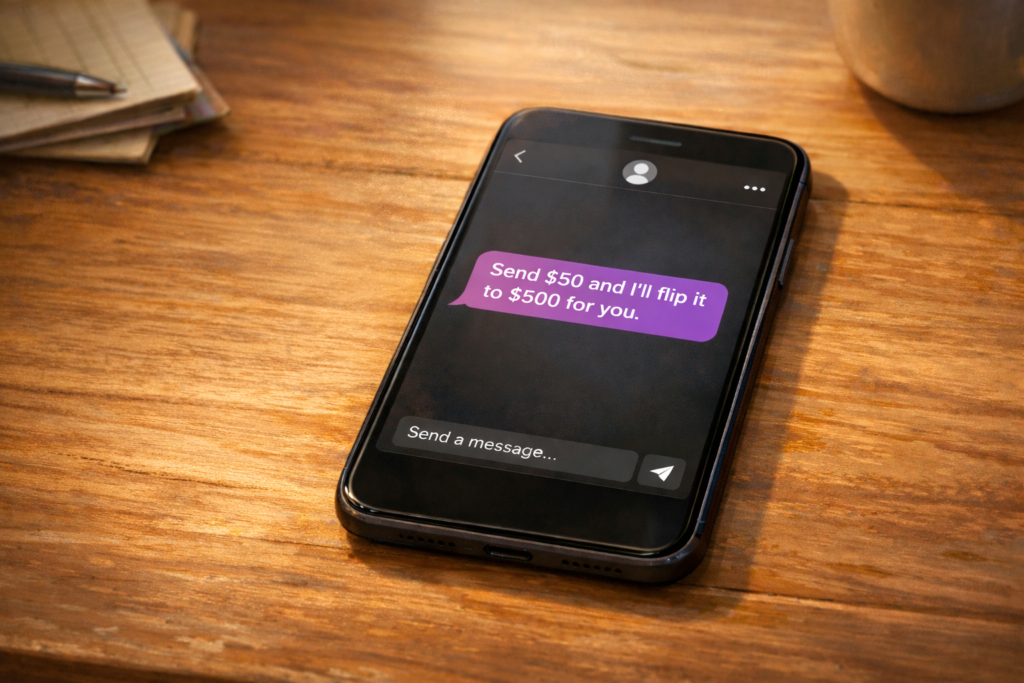
What is the Cash App flip scam on Instagram?
The cash app flip scam on Instagram is a where scammers promise to multiply small payments into large returns. Someone messages you claiming they have a special method—an “algorithm,” a “business system,” or a connection to a wealthy person—that can turn $50 into $500, or $100 into $1,000. They post flashy photos of cash, designer items, and fake testimonials from people who supposedly got rich using their method.
The reality is that there is no flip, there is no investment, there is no system. It’s theft sliding in to your Instagram DMs.
The cash app money flip scam spreads across social media platforms, appearing on TikTok and Facebook as well, but Instagram is where it thrives. Scammers use the platform’s direct messaging to target people looking for fast cash, and they exploit the reality that Cash App transactions are nearly impossible to reverse once sent.
How the Cash App flip scam usually works
The Lure
Scammers start by making themselves visible to potential targets. They post Instagram Stories and Reels showing stacks of cash, fancy cars, and luxury vacations. They comment on official @cashapp posts during real Cash App giveaways, hoping to find account holders. Some follow users who publicly display their $cashtag (the Cash App username starting with $). All of this is designed to catch the attention of someone thinking, “I could use some extra money.”
The Pitch
Once they’ve identified a target, they slide into your DMs. The message is always similar: “Hey, I can flip your money for you. Send $10-$100 and I’ll turn it into $500-$1,000 in 24 hours.” They might claim to have a special connection at a bank, a secret investment strategy, or access to a money-doubling platform. The promise is simple and seductive—free money for doing almost nothing.
Building Trust
To make you feel confident, scammers use social engineering tactics. They may send fake screenshots showing other “customers” who successfully flipped their money. Some go further and actually send you a small profit on your first transaction—maybe you send $20 and get back $30. This creates a false sense of legitimacy and makes you more willing to send larger amounts.
The Escalation
After the small, successful flip, the scammer asks for more. They’ll say things like, “Send $200 and I’ll return $1,000,” or “There’s a $500 minimum to unlock premium returns.” They invent taxes, fees, or “unlock thresholds” that don’t exist. At each stage, your investment grows. And at each stage, you’re more emotionally invested in making the profit.
The Disappearance
Once the scammer has taken a substantial amount—usually somewhere between $200 and $2,000—they vanish. They block your Instagram and Cash App accounts. Your messages go unanswered. The promised return never arrives because it was never going to come. Since Cash App payments are instant and typically non-reversible once sent to another user, the money is already gone, and recovering it is extremely difficult.
How to protect yourself from Cash App flip scams
The Golden Rule: Never Send Money to Strangers
The single most important defense against the cash app flip scam is simple: never send money to someone you don’t know, regardless of what they promise in return. Cash App is designed for payments between friends and family members. It is not a place to conduct investments or financial transactions with strangers online.
Understand the Reality of Real Investments
Real investment opportunities don’t happen through Instagram direct messages. Real financial professionals don’t recruit new clients by flooding social media with photos of cash. Real returns require risk and time—they’re not guaranteed, and they certainly don’t come from sending money to an anonymous person in your DMs. If it sounds too good to be true, it is.
Report, Block, and Don’t Engage
If you encounter a money flip offer in your DMs, report the Instagram account immediately. You can report it by visiting their profile, tapping the three dots, and selecting “Report.” Also report the scammer to Cash App through the app’s support center. Block the account to prevent further contact. Don’t engage with their messages—even saying “no thanks” confirms your account is active and may invite more scammers.
Enable Cash App Security Features
Cash App offers security tools that help protect your account. Enable Cash App’s security lock feature, which adds biometric or PIN protection to your account. Turn on notifications for all transactions so you see immediately if someone tries to send or receive money from your account. Review your transaction history regularly, and if you spot anything suspicious, report it right away.
Verify Before You Trust
If a friend’s Instagram account suddenly starts promoting money flips, be cautious. Their account may have been hacked. Don’t send them money and don’t assume they’ve turned to scamming—contact them directly (by phone or in person) to let them know their account has been compromised.
What to do if you’ve been affected
Report the Transaction
If you’ve sent money to a cash app flip scammer, report it through Cash App immediately. Open the app, find the payment you sent, tap the three dots next to it, and select “Report.” While Cash App can’t always recover stolen money, reporting increases the chances that the scammer’s account will be shut down and prevents others from falling victim to the same person.
Report to Instagram and the FTC
Report the scammer’s Instagram account for fraud or deceptive practices. You can do this from their profile or from the message thread. Beyond social media, file a complaint with the Federal Trade Commission at reportfraud.ftc.gov. The FTC uses these reports to identify scam patterns and take action against networks of scammers.
Contact Your Bank if Necessary
If your Cash App account is linked to a debit card, contact your bank’s fraud department. While Cash App-to-Cash App transfers are usually non-reversible, if a scammer somehow accessed your linked bank account, your bank may be able to help. Explain what happened and ask about your options.
Watch Out for Recovery Scammers
After losing money to a scammer, you may receive messages from people claiming they can recover your funds for a small upfront fee. These are recovery scammers—a second layer of fraud that preys on people who’ve already been victimized. No one can guarantee they’ll get your money back from a scammer. If someone offers to recover your Cash App funds for a fee, that’s a scam.
Don’t Feel Embarrassed
Falling for a cash app flip scam doesn’t make you foolish. These scams are specifically designed to exploit hope and trust. Scammers study psychology and use proven manipulation tactics. Thousands of people lose money to these schemes, and many don’t report it because they feel ashamed. Don’t let that silence prevent you from reporting—the data helps law enforcement understand the scope of the problem.