
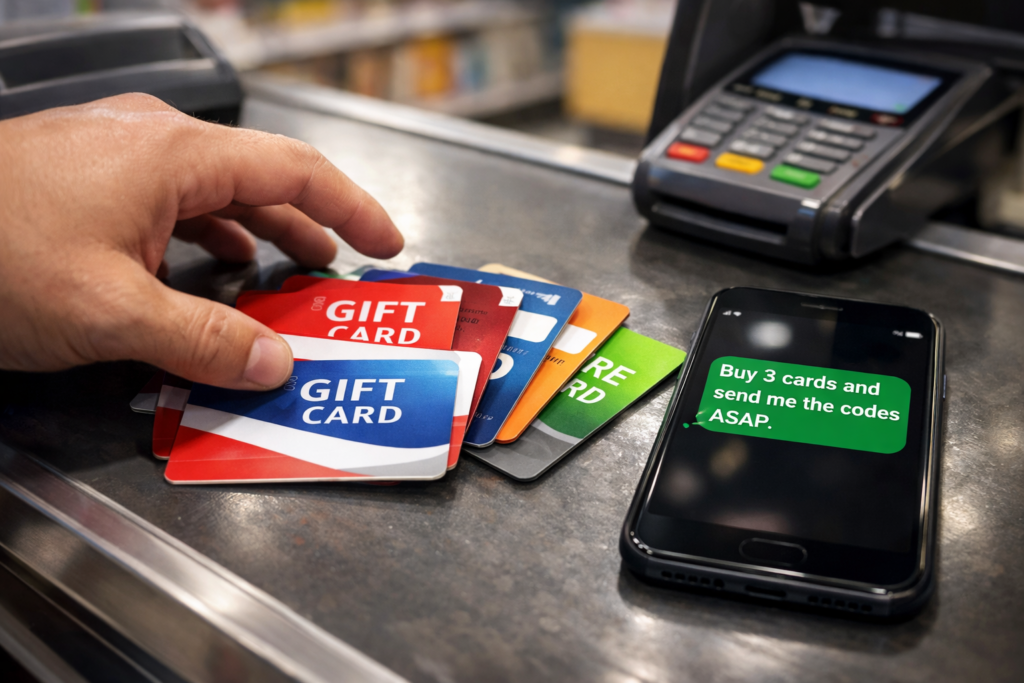
What is the scam?
Gift card scams happen when a scammer tricks you into buying gift cards and sharing the card numbers and PINs as a form of payment. The scammer may be posing as your boss, a government agent, a tech support worker, a romantic interest, or a family member in crisis. The story varies, but the payment method is always the same: go to a store, buy gift cards, and read the numbers off the back.
Gift cards are one of the most common payment methods in scams because they work like cash — once the numbers are shared, the money is spent within minutes and is nearly impossible to recover. The FTC reported that Americans lost at least $212 million to gift card scams in 2024, with over 41,000 reports filed. About one in four people who report losing money to any type of fraud say gift cards were the payment method. The actual losses are almost certainly much higher, since most victims don’t report these crimes.
For a deeper look at why scammers specifically request gift cards over other payment types, see our article on Why Scammers Ask For Gift Cards, Crypto, and Zelle.
How this scam usually works
Gift card scams aren’t a single scam type — they’re a payment method used across many different scam scenarios. Here are the most common ways scammers get you to pay with gift cards.
Government impersonation scams
Someone calls claiming to be from the IRS, Social Security Administration, or another government agency. They tell you that you owe back taxes, your Social Security number has been compromised, or there’s a warrant for your arrest. To “resolve” the issue, they instruct you to go to a nearby store and buy gift cards — usually Apple, Google Play, or Target cards — and read the numbers over the phone.
This version is especially common in the IRS impersonation scam and the Social Security scam. The scammer knows that once you read those card numbers, the money is gone instantly. No legitimate government agency accepts gift cards as payment — not the IRS, not the SSA, not local law enforcement. This is a scam every time.
Boss and colleague impersonation scams
You receive a text or email that appears to be from your boss, a company executive, or a coworker. The message says they’re in a meeting and can’t talk, but they need you to buy gift cards for a client gift, a team appreciation event, or a business purpose. They ask you to purchase the cards quickly and send photos of the backs.
The message usually creates urgency — “I need this done in the next hour” — and relies on your instinct to respond quickly when a superior asks for help. A woman in suburban Chicago lost over $5,000 after receiving an email she believed was from her company’s CEO requesting Target and Best Buy gift cards. By the time she checked the full email address and realized it was fake, the card numbers had already been redeemed. This tactic is a variation of the friend or family impersonation scam, adapted for the workplace.
Tech support scams
A pop-up appears on your computer warning that your device is infected with malware. The message includes a phone number to call for “Microsoft support” or “Apple support.” When you call, the person on the line tells you your computer is compromised and that you need to pay for a security service or software license — using gift cards.
A 70-year-old woman in California lost $24,000 after a fake pop-up on her computer directed her to call what she believed was Microsoft support. Over multiple calls, she was instructed to purchase gift cards from various stores and provide the numbers.
Romance and relationship scams
A person you’ve been building a relationship with online — on a dating app, social media, or messaging platform — asks you to send gift cards to help with an emergency. The story might involve a medical bill, a stranded travel situation, a legal problem, or a business deal that needs quick funding.
One elderly victim reported losing $31,000 through gift card payments as part of a romance scam that played out over months. The emotional bond made each request feel like helping a loved one rather than funding a scammer. For more on how these relationships are manufactured, see our article on the online romance scam.
Prize and lottery scams
You’re told you’ve won a sweepstakes, lottery, or contest. To claim your prize, you need to pay “taxes” or “processing fees” — in gift cards. The scammer may send you a fake check to cover the fees (which will bounce) or simply pressure you to pay out of pocket with the promise that you’ll be reimbursed from your winnings.
Gift card tampering at retail stores
This version doesn’t involve a phone call or email at all. Scammers physically tamper with gift cards on store display racks. They copy the card numbers and PINs from cards still hanging on the rack, then reseal the packaging so nothing looks disturbed. When a legitimate customer buys that card and loads money onto it, the scammer — who already has the card number — drains the balance immediately.
Police in Fairfax County, Virginia arrested two men who were found stocking shelves at a Target store with altered gift cards linked to outside accounts. When a customer bought one of those cards, the money went directly to the scammer’s account.
How it works step by step
- You receive a message that creates urgency. A call, text, email, or pop-up tells you there’s a problem — unpaid taxes, a compromised account, a work emergency, a loved one in trouble — that needs immediate attention.
- The scammer tells you to buy gift cards. They specify the brand and amount: “Go to Walmart and buy three $500 Apple gift cards.” They may tell you which stores to visit and how much to buy at each.
- They coach you on what to say at the store. Scammers know that store clerks sometimes ask why customers are buying large quantities of gift cards. They’ll tell you to say the cards are for birthday gifts or business rewards if anyone asks.
- You buy the cards and share the numbers. Once you have the cards, the scammer asks you to scratch off the coating on the back and read the card numbers and PINs over the phone, or send photos of the backs via text or email.
- The money is spent within minutes. The scammer redeems or resells the card balances almost immediately. By the time you realize you’ve been scammed, the money is gone.
- They ask for more. If you’ve complied once, the scammer often calls back with another “issue” that requires additional gift cards. Some victims make multiple trips to multiple stores over days or weeks.
Real-world examples
A suburban Chicago office worker lost more than $5,000 after receiving an email she thought was from her company’s CEO. The email asked her to buy Target and Best Buy gift cards for a client appreciation event. The tone was professional, the request seemed reasonable, and she acted quickly. When she later checked the full sender address, she saw it was a spoofed email. The card numbers had already been redeemed.
A 70-year-old woman in California lost $24,000 in a tech support scam. A pop-up on her computer directed her to call a fake Microsoft support number. Over multiple calls, she was told her computer was severely compromised and that she needed to purchase gift cards to pay for security software and services. The scammer kept her on the phone and guided her through each purchase.
An elderly woman lost $31,000 through gift card payments as part of a romance scam. Over months, she built what she believed was a genuine relationship with someone she met online. The person asked for gift cards to help with a series of emergencies. Each individual request felt manageable, but the total grew rapidly.
Two men were arrested in Fairfax County, Virginia for tampering with gift cards at a Target store. Officers observed them placing altered cards on store shelves. The cards were designed to redirect money loaded by legitimate buyers to accounts controlled by the scammers. The U.S. Department of Homeland Security has warned that organized crime groups are behind similar card-tampering operations nationwide.
Red flags: Legitimate gift card use vs. scam
| Legitimate Gift Card Use | Gift Card Scam Warning Signs |
|---|---|
| Buying a gift card as a present for someone you know | Being told to buy gift cards as “payment” for a debt, fee, or service |
| Purchasing from a store’s display for personal use | Being coached on what to tell the store clerk if they ask why |
| The card’s packaging is sealed and undamaged | Packaging looks resealed, the PIN area is scratched, or the barcode has a sticker over it |
| No one asks you to read the numbers off the back | Someone asks you to share card numbers and PINs by phone, text, or email |
| You choose the brand and amount yourself | Someone specifies the exact brand, amount, and number of cards to buy |
| No urgency or pressure | “Buy them now — this has to be resolved today” |
| No government agency or company asks for gift card payment | A “government agent” or “company rep” insists gift cards are the required payment method |
Which gift cards do scammers prefer?
Scammers have clear brand preferences. According to FTC data, Apple gift cards are the most commonly requested, accounting for about 30% of gift card scam reports. Target gift cards come second at 14% of reports but result in the highest average losses — the median reported loss when scammers requested Target cards was $2,500, with 30% of those victims losing $5,000 or more. eBay, Walmart, Google Play, and Amazon cards round out the most-targeted brands.
Scammers prefer these brands because they’re widely available, easy to redeem or resell, and have high per-card value limits. Apple gift cards in particular can be redeemed digitally without a physical card, making them ideal for instant extraction.
How to protect yourself
Know that no legitimate organization accepts gift cards as payment. Not the IRS, not Social Security, not your bank, not any utility company, not any court. If anyone asks you to pay for anything with gift cards, it’s a scam. There are no exceptions to this rule. For a broader look at what legitimate companies do and don’t ask for, see What Real Companies Will Never Ask You To Do.
Verify “boss” and “colleague” requests through a second channel. If you receive a text or email from your boss asking you to buy gift cards, call them directly on a number you already have — don’t reply to the text or email. If they’re really in a meeting, they’ll get back to you. Real workplace requests can wait for verification.
Inspect gift cards before buying. Check that the packaging is intact, the PIN area hasn’t been scratched or tampered with, and there are no stickers covering the original barcode. If anything looks off, pick a different card or ask a store employee for cards from behind the counter.
Slow down. Every gift card scam depends on urgency. The scammer needs you to act before you think. If someone is pressuring you to buy gift cards immediately, that pressure itself is the clearest sign of a scam. Take a breath, hang up, and verify.
Tell store clerks what’s happening. If you’re at a register buying gift cards and something feels wrong, tell the cashier. Many retailers have trained employees to recognize gift card scam patterns and may be able to intervene. There’s no embarrassment in asking — store employees see this regularly.
What to do if you’ve been affected
Contact the gift card company immediately. Call the customer service number for each card brand. Some companies can freeze the remaining balance if the funds haven’t been fully redeemed yet. Key numbers include Apple (800-275-2273, say “gift cards”), Google Play (support.google.com/googleplay), Amazon (888-280-4331), and Target (800-544-2943).
Save the cards and receipts. Keep every gift card, receipt, and screenshot of communication with the scammer. These are evidence for any investigation or recovery attempt.
Report the scam:
- File a report with the FTC at reportfraud.ftc.gov
- Report to your local police department — especially for larger losses
- File a complaint with the FBI’s IC3 at ic3.gov
- If the scam started with a work email, report it to your company’s IT department
Monitor your accounts. If you shared any personal information during the scam — bank details, Social Security number, or login credentials — take steps to secure those accounts. Place fraud alerts on your credit reports if your SSN was involved.
Know that recovery is difficult but not impossible. Gift card companies have become more responsive to fraud reports in recent years. Apple settled a $35 million class action lawsuit related to iTunes gift card fraud. The sooner you contact the card issuer, the better your chances of recovering any remaining balance.