
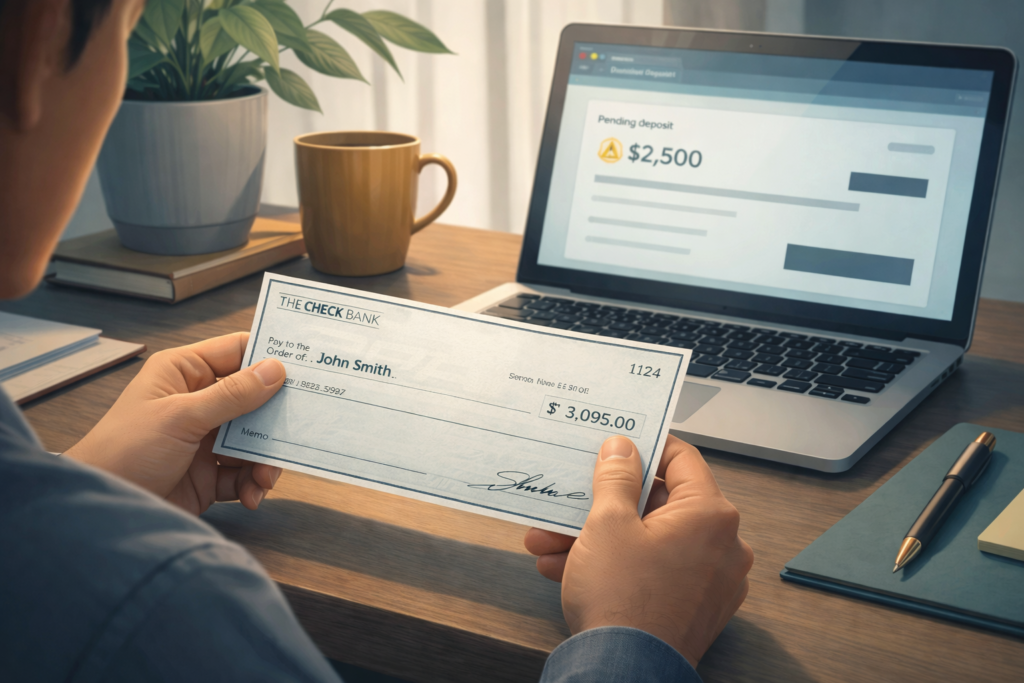
What is the scam?
The fake check scam tricks you into depositing a counterfeit check — a cashier’s check, money order, or personal check — and then sending part of the money back to the scammer before your bank discovers the check is fake. When the check bounces days or weeks later, the bank reverses the deposit and you’re responsible for the full amount, including any money you already sent to the scammer.
This scam works because of a gap in how the banking system processes checks. Federal regulations require banks to make deposited funds available within one to two business days. But it can take weeks for a bank to verify that a check is legitimate. During that window, the money appears in your account and feels like it’s yours — but it isn’t. Scammers exploit this timing gap to pressure you into sending money before the fraud is discovered.
Check fraud has surged in recent years. The U.S. Treasury reported in early 2024 that check fraud increased 385% nationwide since the start of the pandemic. FTC data shows that adults ages 20 to 29 are the most targeted age group, making up 21% of fake check scam victims. This scam is closely related to the overpayment scam, which uses the same mechanics in the context of buying and selling.
How this scam usually works
Fake check scams appear in several common scenarios. The story changes, but the mechanics are always the same: you receive a check, deposit it, send money back, and the check turns out to be fake.
The marketplace overpayment version
You list something for sale online — furniture, a car, electronics. A buyer contacts you and agrees to purchase the item. They send a check for significantly more than the asking price. They explain the overpayment as an accident, or claim the extra money is meant to cover shipping or a delivery service.
The buyer asks you to deposit the check and send the difference back — usually via wire transfer, Zelle, or gift cards. You deposit the check, see the funds appear in your account within a day or two, and send the “extra” money. A week or two later, your bank notifies you that the check was counterfeit. The full deposit amount is reversed, and the money you sent to the buyer is gone. You’ve lost the item, the “overpayment” refund, and potentially face overdraft fees.
This version also appears on Facebook Marketplace, Craigslist, and other platforms. For more on marketplace-specific scams, see our guide on the Facebook Marketplace Zelle scam.
The employment and work-from-home version
This version targets job seekers — especially young adults. You apply for or are contacted about a job, often a remote position found on LinkedIn, Indeed, or social media. After a brief “interview” conducted entirely by text or email, you’re “hired.”
Your new employer sends you a check — often $2,000 to $5,000 — to purchase home office equipment, software, or supplies from a specific “approved vendor.” You deposit the check, buy the items as instructed (sending money to the “vendor”), and the equipment never arrives. The check bounces, and you owe the bank the full amount.
The BBB found that 43% of employment scams reported by 18-to-24-year-olds involved fake checks, with a median loss of $1,819. The fake job offer scam article covers employment scams in more detail.
The mystery shopper version
You’re recruited to be a “mystery shopper” — someone paid to evaluate customer service at stores and businesses. The company sends you a check with instructions to deposit it, keep a portion as your payment, and then use the rest to purchase gift cards, wire transfers, or money orders as part of your “evaluation.”
You complete the assignment and send the gift card numbers or wire transfer confirmations to the company. The check bounces, and your “payment” is reversed along with it. The gift cards you purchased cannot be recovered because the scammer already redeemed them. For more on why scammers request these payment types, see Why Scammers Ask For Gift Cards, Crypto, and Zelle.
The lottery and sweepstakes version
You receive a letter, email, or social media message claiming you’ve won a prize — a lottery, a sweepstakes, or a contest. To claim your winnings, you’re told you need to pay taxes or processing fees upfront. The scammer sends you a check that appears to cover the fees and instructs you to deposit it, keep a portion, and wire the “tax payment” to a specified account.
The check is fake. Your “winnings” don’t exist. And you’ve wired your own money to a scammer. In one case, an 82-year-old man in Florida was told he’d won a sweepstakes worth millions and was convinced to hand over $19,500 in “tax” payments collected in person by someone posing as an IRS agent.
The rental deposit version
You find a rental listing online at an attractive price. The landlord — who communicates only by email or text — sends you a check as a “moving allowance” or “deposit refund” from the previous tenant. They ask you to deposit the check and send a portion to a third party (a moving company, a cleaning service, or back to the “previous tenant”). The check is counterfeit, the rental doesn’t exist, and your money is gone.
How it works step by step
- You’re presented with a plausible reason to receive a check. A sale, a job, a prize, a rental — the scenario gives you a logical explanation for why someone is sending you money.
- You receive the check. It looks professional and legitimate. Fake cashier’s checks are often nearly indistinguishable from real ones. They may include real bank names, routing numbers, and watermarks. Advanced Fraud Solutions reports adding about 150,000 new fake check alerts monthly from financial institutions across the country.
- You deposit the check. Your bank makes the funds available within one to two business days, as required by federal law. The money appears in your account.
- You send money to the scammer. The scammer asks you to wire the “extra” money, buy gift cards, or send a payment to a third party. Because the funds are showing in your account, you believe the check has cleared.
- The check bounces. Days or weeks later, your bank discovers the check is counterfeit. The full deposit amount is reversed from your account.
- You’re left owing the money. The money you sent to the scammer is gone. Your bank holds you responsible for the deposited amount. You may face overdraft fees, a frozen account, or even account closure.
Real-world examples
Sara (reported by the BBB) accepted a remote job offer she found on LinkedIn. Her new “employer” sent her a cashier’s check for $5,000 to purchase home office equipment from an “approved vendor.” She deposited the check, saw the funds in her account, and wired the money to the vendor. The equipment never arrived. A week later, her bank notified her the check was counterfeit. The $5,000 was reversed from her account, and the wire transfer could not be recovered. She was left owing her bank the full amount.
A ring targeting law firms operated across the U.S. and Canada, contacting attorneys with fake debt collection cases. The “debtor” would send a counterfeit check as settlement payment. The law firm would deposit the check, take its legal fee, and wire the remainder to the “client.” When the checks bounced, the firms were responsible. This operation stole more than $70 million before it was disrupted.
Cortez Nelson-Bey Sr. of St. Louis entered a bank in spring 2023 with a counterfeit check for $1,860. Over the next two days, he cashed five additional fake checks, stealing $11,147 in total. He was charged with five counts of accessory to forgery.
Young adults across the country continue to be disproportionately targeted through employment scams on social media. The BBB’s 2023 youth scam report found that employment scams were the most prevalent type affecting 18-to-24-year-olds, accounting for 30% of scams reported by this age group. The median loss was $1,819, and nearly half of those employment scams involved fake checks.
Red flags: Real check vs. fake check scam
| Legitimate Check Situation | Fake Check Scam Warning Signs |
|---|---|
| Check amount matches what was agreed upon | Check is for more than the agreed amount |
| No one asks you to send money back | You’re asked to wire, Zelle, or gift-card part of the deposit back |
| The payer doesn’t pressure you to act fast | Urgency: “Deposit it today and send the difference right away” |
| You know the payer personally or through a verified business | The payer is someone you met online or only communicated with by text/email |
| Payment is for a clear, agreed-upon purpose | You’re being “paid” to shop, evaluate, or forward money |
| No one contacts you about a prize you didn’t enter | You “won” a contest or lottery you never entered |
| Employer payroll comes through direct deposit or verified payroll company | New “employer” sends a physical check before you start working |
How to protect yourself
Wait for the check to fully clear before spending any of the money. Your bank may make funds available in one to two days, but that doesn’t mean the check has been verified. Ask your bank specifically: “Has this check fully cleared and been verified by the issuing bank?” Don’t rely on the funds showing in your account as proof the check is good.
Never send money back to someone who overpaid you by check. If a buyer sends you a check for more than the asking price and asks for a refund of the difference, it’s a scam. A legitimate buyer will cancel the check and send a new one for the correct amount. If they refuse to do that, you have your answer.
Verify checks independently. If you receive a cashier’s check, call the issuing bank to verify it. Look up the bank’s phone number yourself — don’t use a number printed on the check, as scammers include fake customer service numbers on counterfeit checks.
Be skeptical of jobs that send you a check before you start working. Legitimate employers don’t send new hires checks for thousands of dollars to buy equipment from unnamed vendors. If a job requires you to deposit a check and forward money to a third party, it’s a scam — regardless of how professional the company appears. For more on how legitimate businesses operate, see What Real Companies Will Never Ask You To Do.
Don’t accept checks from strangers. If someone you’ve never met in person wants to pay you by check — especially a cashier’s check — treat the situation with extreme caution. This applies to online marketplaces, social media contacts, and anyone who reached out to you unsolicited.
Understand that you’re legally responsible. When you deposit a check, you’re vouching for it. If the check turns out to be fake, federal law holds you — not the bank — responsible for the amount. This is true even if you were the victim of a scam. Understanding this liability is the most important reason to verify every check before spending any of the money.
What to do if you’ve been affected
Contact your bank immediately. Tell them you believe you deposited a counterfeit check. The sooner you report it, the better your chances of limiting the damage. If you haven’t yet sent money to the scammer, don’t. If you have, provide your bank with all the details of where the money went.
Report the scam:
- File a complaint with the FTC at reportfraud.ftc.gov
- Report to the FBI’s IC3 at ic3.gov
- File a report with your state’s attorney general
- If the fake check used a real bank’s name, notify that bank as well
If the scam came through a job listing, report it to the platform. Report the fraudulent employer on LinkedIn, Indeed, or wherever you found the listing. This helps prevent others from being targeted.
Document everything. Keep the fake check (don’t destroy it — it’s evidence), along with screenshots of all messages, emails, and any job postings or listing ads connected to the scam.
Monitor your bank account closely. Watch for additional unauthorized transactions. If the scammer obtained any of your banking information during the process, they may attempt further fraud. Consider changing your account number if you shared sensitive details.
Watch for follow-up scams. Fake check scam victims are sometimes contacted again by someone claiming to be able to recover the lost funds — for a fee. This is a second scam targeting the same victim. Legitimate recovery assistance from law enforcement is always free.